Four Principles That Help Productivity Flow Naturally
Introduction: Your Desk Is Quietly Shaping the Way You Work
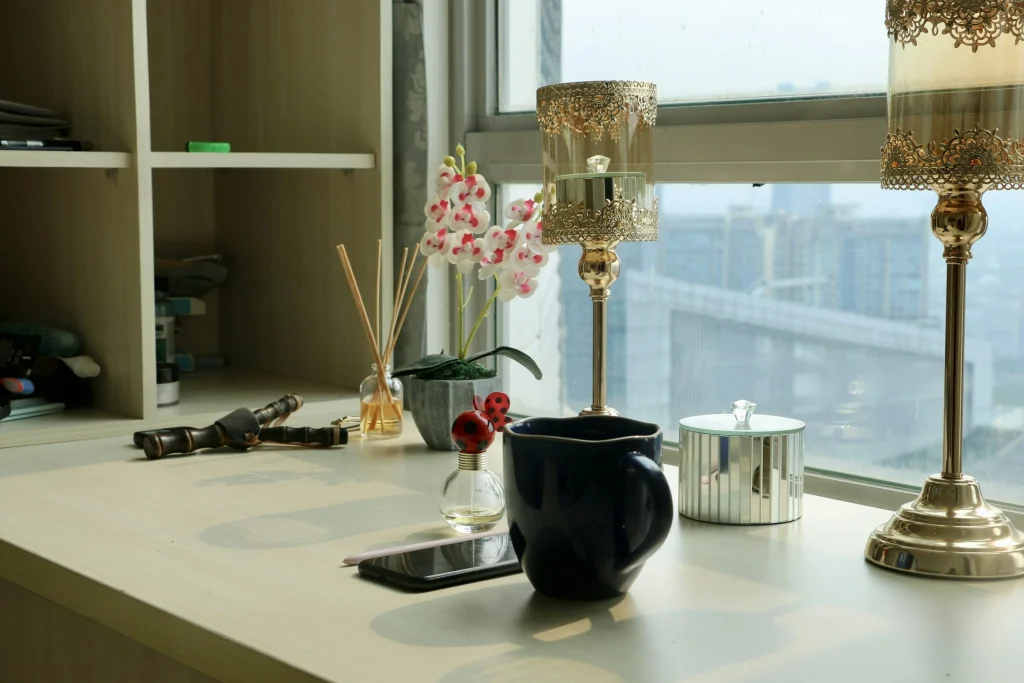
Have you ever noticed that in some spots, your mind feels clear, your work flows easily, and time seems to move faster — while in other places, you feel distracted, tired, and mentally stuck?
That’s not just in your head.
In Eastern traditions, the workspace is linked to the flow of thought, focus, and learning. In modern environmental psychology, there’s a similar idea: the spaces we work in directly influence attention, creativity, and the quality of our decisions.
Different language, same truth: where you work often matters just as much as how you work.
So today, let’s leave mysticism aside and focus on what you can actually feel every day: concentration, ease, clarity, and the sense of not being quietly drained by your environment. These common workspace details may be the reason your productivity feels inconsistent from one day to the next.
1. Should Your Desk Face the Wall or the Window? The Answer Isn’t So Absolute
A lot of people get stuck on this question when setting up a workspace.
Facing a wall can absolutely make it easier to focus. Your eyes are less likely to wander, and there’s less visual distraction. But after a while, it can also start to feel a little closed in, almost like working in a corner.
Facing a window, on the other hand, feels more open and breathable. It can lift your mood and make the space feel lighter. But people passing by, moving cars, changing light, and outdoor activity can slowly pull your attention away.
So the answer isn’t one or the other. It really depends on the kind of work you do.
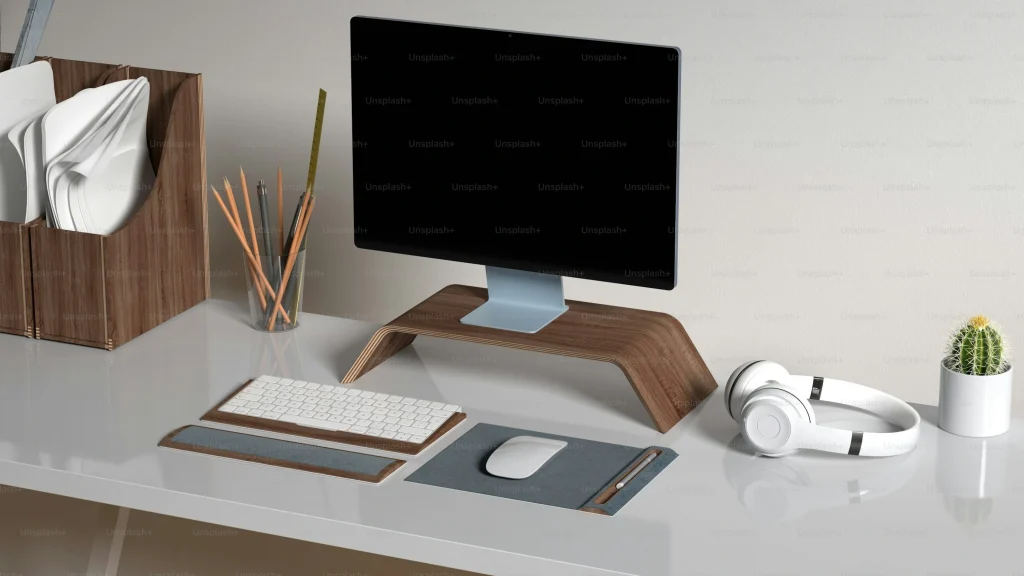
If your work requires long stretches of deep focus, a quieter setup with less visual input is usually more supportive. Facing a wall, a bookshelf, or a clean, calm surface often helps the brain settle into a more stable rhythm. When there’s less movement in your field of vision, the brain has less irrelevant information to process.
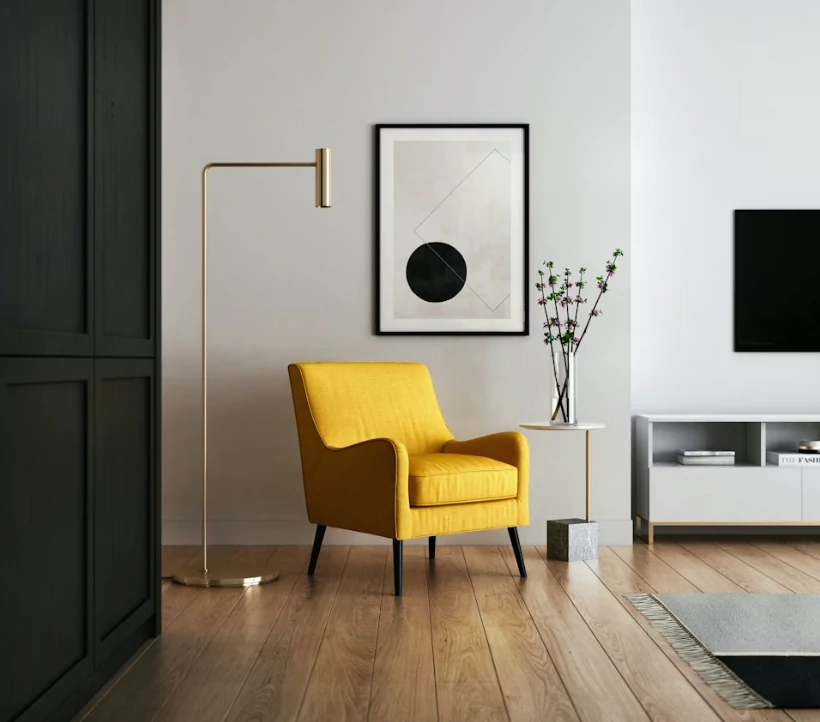
That said, the space in front of you doesn’t need to be completely blank. A soft visual landing point — an abstract print, a simple inspiration card, or something subtle — can help. The goal isn’t to make the wall more interesting. It’s to give your eyes somewhere to rest without pulling your attention away.
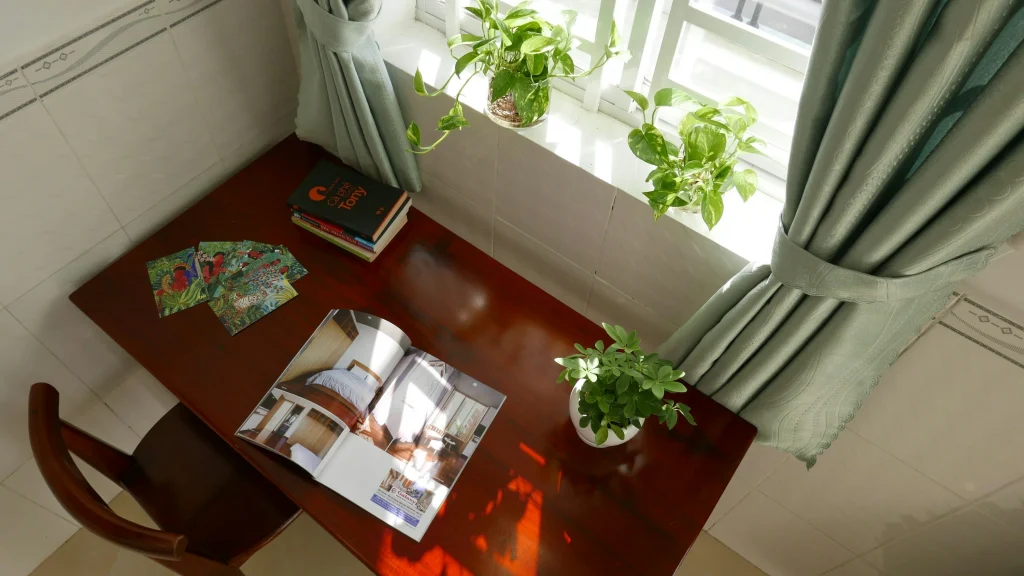
If your work leans more creative, being closer to a window may actually work better. Natural light, shifting shadows, the sky, the weather — these gentle external cues can help the mind loosen up and generate new ideas more easily.
The ideal setup usually isn’t having the desk directly face the window, but placing the window slightly to one side, in your side-front view. That way, you still get the openness and energy of the outside world without being constantly pulled into it.
If you have enough room, you can even create two different working modes: one quieter spot for deep focus, and another more open area for brainstorming and creative thinking. That’s not overcomplicating things — it’s simply designing with the brain’s natural rhythms in mind.
2. Where You Sit Really Does Affect Your Efficiency
Some spots simply make it easier to get into the zone.
In spatial design, there’s an interesting idea you could think of as the “position of control.” It usually shares a few common features: there’s something solid behind you, the view in front of you feels open enough, you can see the entrance without being directly in line with it, and the light feels comfortable.
Why does this kind of position work so well? Because when a person feels safe in a space, the brain doesn’t have to spend as much energy monitoring the environment. That frees up more attention for the work itself.
Put simply, a good working position often gives you three things at once: you can see clearly, feel supported, and stay grounded.
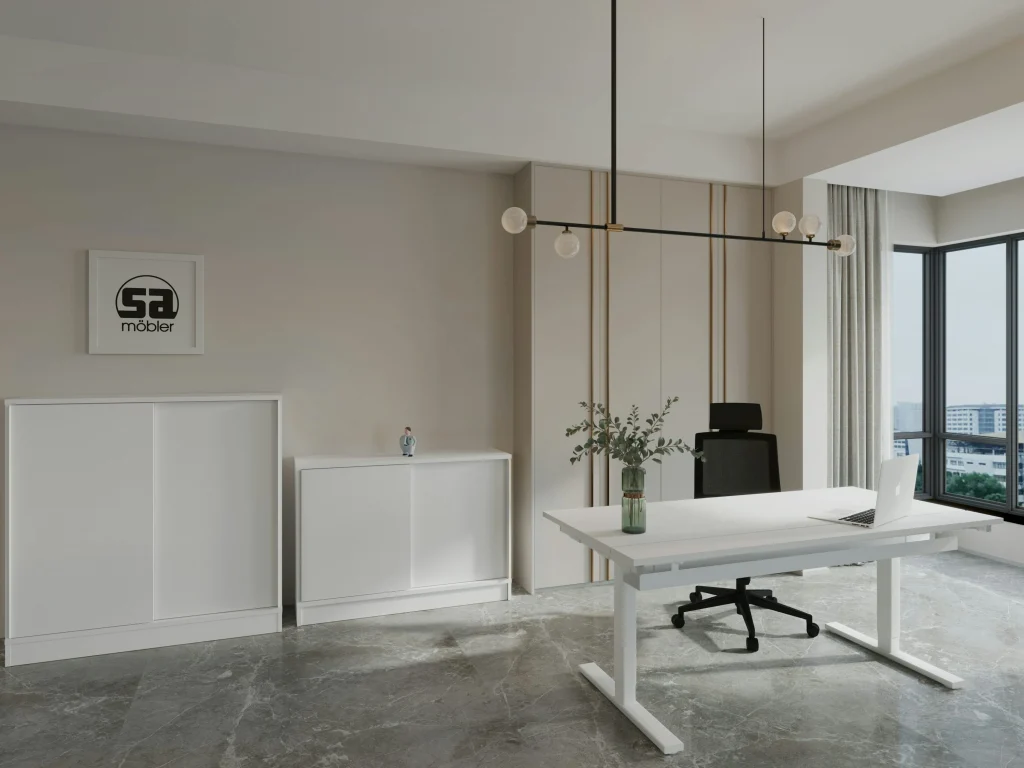
If you can choose where to sit, look for a place where there’s a wall behind you, some visual openness ahead, and natural or soft light to the side. That combination often helps people settle into work faster.
If your office or home setup is fixed, don’t worry too much. Small adjustments can still make a big difference.
If there’s a wall very close in front of you, adding a piece of art, a light, or a few simple layered details can help the space feel less cramped. The goal isn’t to fill it up, but to give the area a little breathing room.
If there’s a beam, cabinet, or anything overhead that feels visually heavy, you can soften that pressure with lighting, fabric, or plants. You may not be able to change the structure itself, but you can change how the space feels around you.
Sometimes a change in position has a much bigger effect than people expect. Many assume they’re simply having an off day, when really, they may just be working in the wrong spot.
3. If the Door Is Behind Your Desk, What’s the Most Practical Fix?
If your desk has a door behind it, or your back faces a walkway where people pass often, that can be one of the more draining layouts to work in.
The reason is simple. In that position, you tend to stay subtly aware of every approaching footstep, and you may unconsciously anticipate someone appearing behind you. Over time, that constant low-level alertness chips away at your attention and makes work feel more fragmented and tiring.
The easiest solution is often to adjust the angle of the desk.
Even a small shift can help.Sometimes a change of just 30 to 45 degrees is enough to make the room feel much more comfortable.
If the desk can’t be moved at all, try creating a little more sense of boundary between you and the door.
That boundary doesn’t need to be dramatic, and it doesn’t need to block the space completely. A high-backed chair, a slightly taller plant, an open shelf, or even a small rug can create the feeling that this is your work zone. Once a space feels more defined, people often feel calmer in it too.
Another practical solution is using a mirror. Not for decorative reasons, but because it genuinely reduces the need to keep turning around. You don’t need to stare at the door — just knowing you can notice movement in that direction is often enough to help the brain relax.
4. What You Keep in Your Workspace Can Make Your Thinking Clearer
A good workspace doesn’t have to contain a lot. Usually, it just feels balanced.
Some objects help you feel steadier and more focused. Others quietly steal your attention.
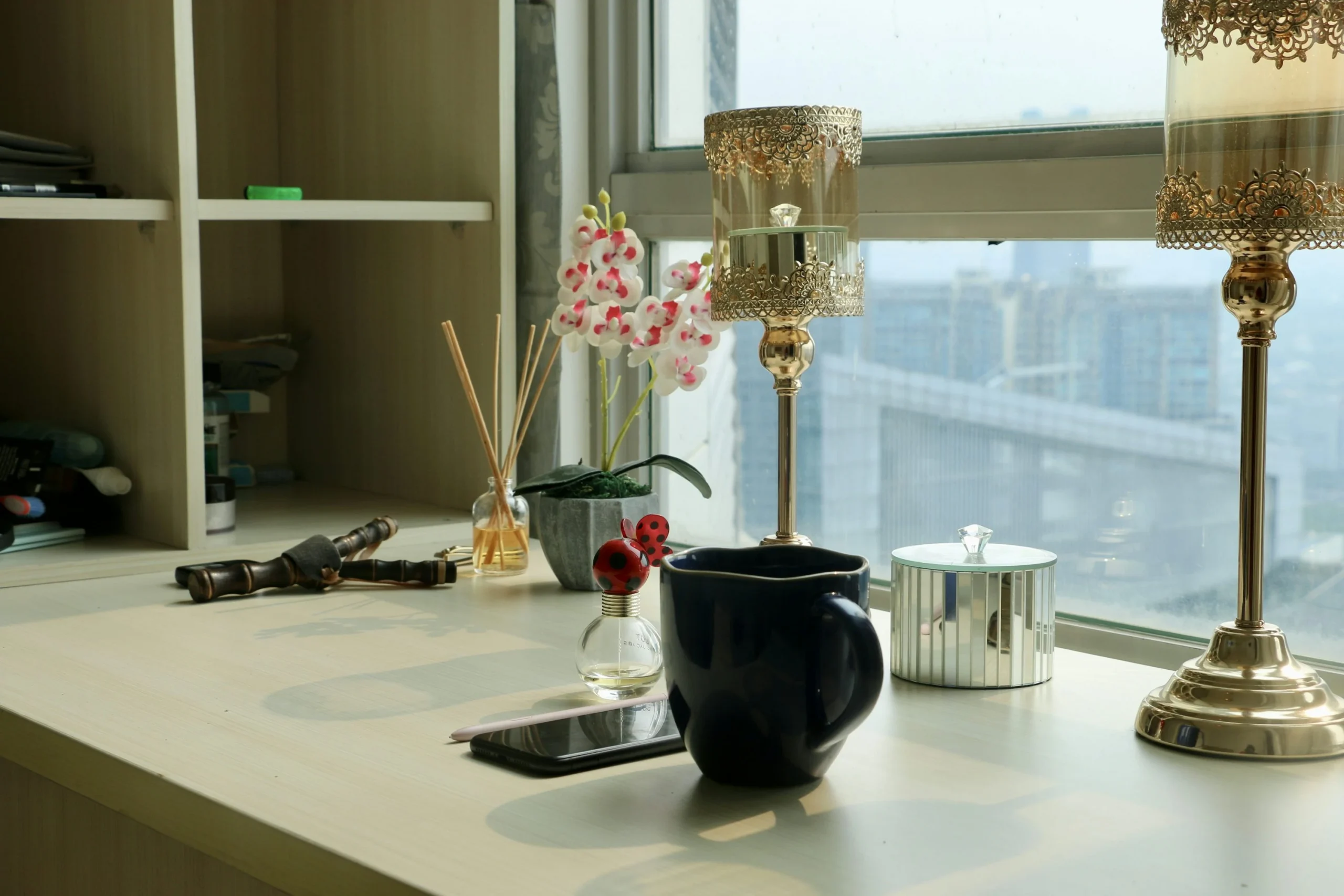
One of the most helpful things you can add is a little life — for example, a plant. A touch of green instantly softens the space, and it gives your eyes a small break from screens and documents. It doesn’t need to be large. A simple, easy-to-care-for plant is enough. The point isn’t decoration for its own sake, but making the workspace feel less dry and mechanical.
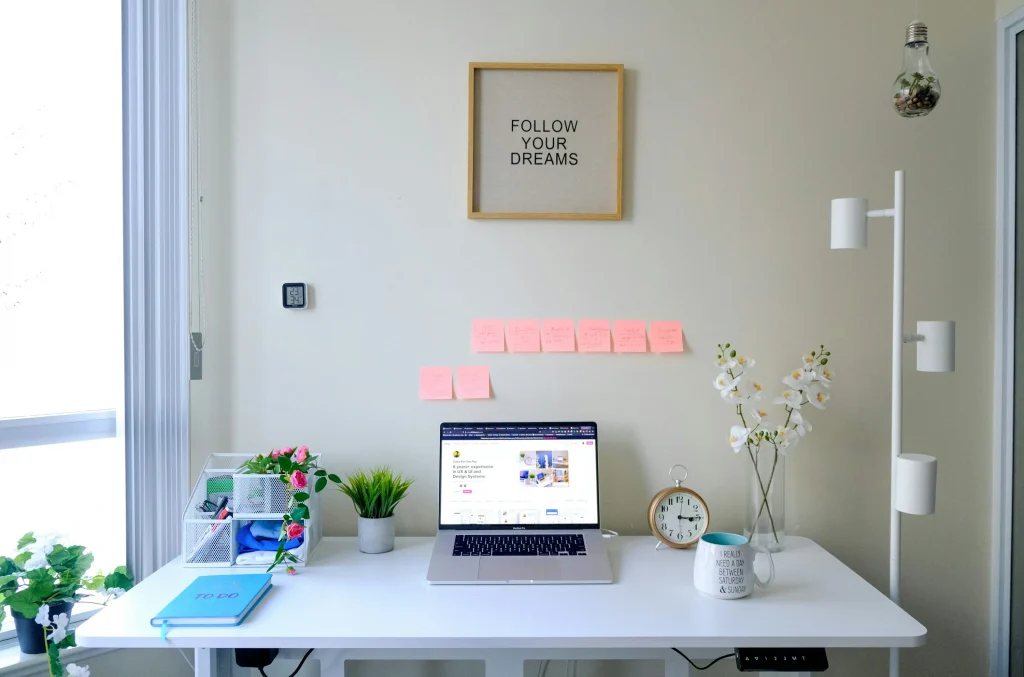
Another helpful category is anything that adds a sense of order. Natural stone, a small object with clean structure, or something that feels simple and grounded can all do this. These things may not literally “raise your energy,” but visually, they tell the brain that this is a place with clarity, structure, and boundaries. And when work gets mentally complex, that feeling matters.
A small number of personal items can help too. Maybe it’s a photo, or a small object that makes you feel calm. Their job isn’t to decorate the desk, but to remind you that this space belongs to you. One or two meaningful pieces are often enough. Too many, and the desk starts to feel visually crowded.
Very often, what matters even more than what to add is what to remove.
Every piece of clutter on the desk takes up a little bit of mental space. Unsorted papers, random objects, small items you keep meaning to deal with — all of them can leave the brain with a subtle sense that something is unfinished. When the environment feels messy, thinking often feels messy too.
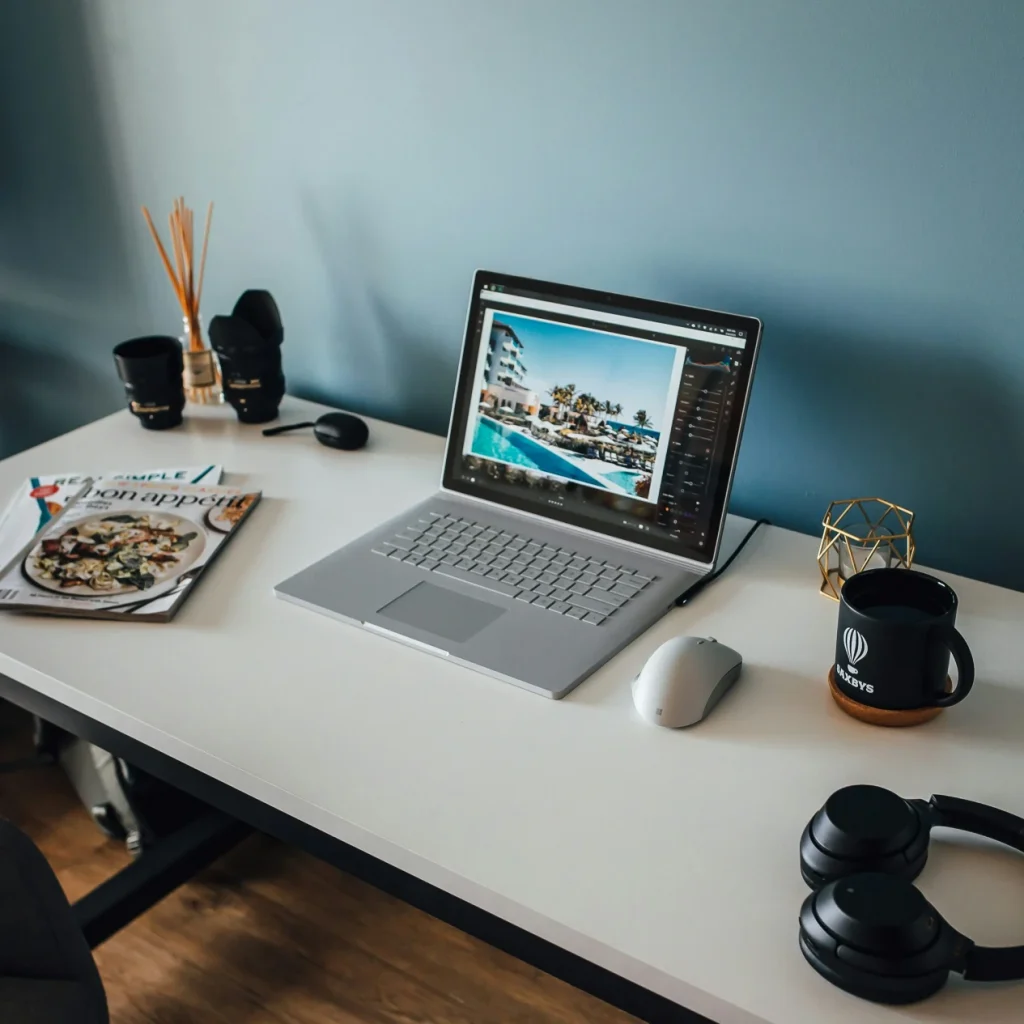
And then there are cables. Charging cords, power wires, adapters — once they start spreading across the desk, the space can feel visually noisy. You may not consciously notice it anymore, but the brain still registers that sense of disorder. Tidying up the cables can make the whole workspace feel calmer.
5. One More Overlooked Detail: Lighting
When people set up a workspace, they often focus on the desk, chair, storage, or accessories. But lighting is usually one of the most immediate influences on how the space feels.
A comfortable workspace is rarely lit by just one overhead light.
Ceiling lights are useful, of course, but if the whole room depends on a single top light, the result can feel too flat, too harsh, or full of awkward shadows. Over time, that kind of lighting becomes tiring for the eyes.
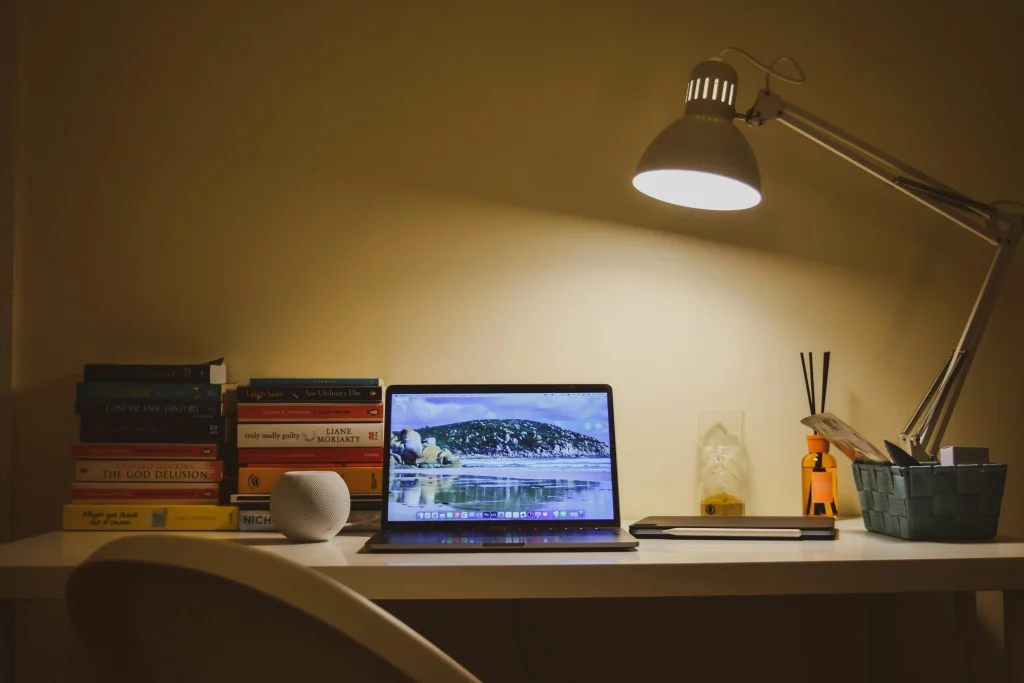
The most comfortable lighting usually has a little more layering. General room light helps the space feel balanced, while a desk lamp gives focused light for the task at hand. It also helps if there’s a softer supporting light somewhere in the room, so the space doesn’t feel too stark.
If you only make one upgrade, make it a good desk lamp.
It doesn’t need to be complicated, but it helps if you can adjust the angle and brightness. The light should illuminate what you’re doing, not shine directly into your eyes. For anyone who works long hours, that small change is often incredibly worthwhile.
It also helps to pay attention to glare. If your desk sits with the window directly behind it, reflections on the screen can become tiring. And if the light is too cold and white — especially later in the day — the whole space can start to feel more tense than clear.
The most comfortable work light is usually bright enough to keep you alert, but soft enough that your eyes don’t feel like they’re working overtime.
Conclusion: Your Workspace Is Really an Extension of Your State of Mind
In the end, setting up a workspace isn’t about making it look more professional, and it’s not about following some fixed formula.
It comes down to a much more practical question:
What kind of environment best supports you when you’re trying to do your best work?
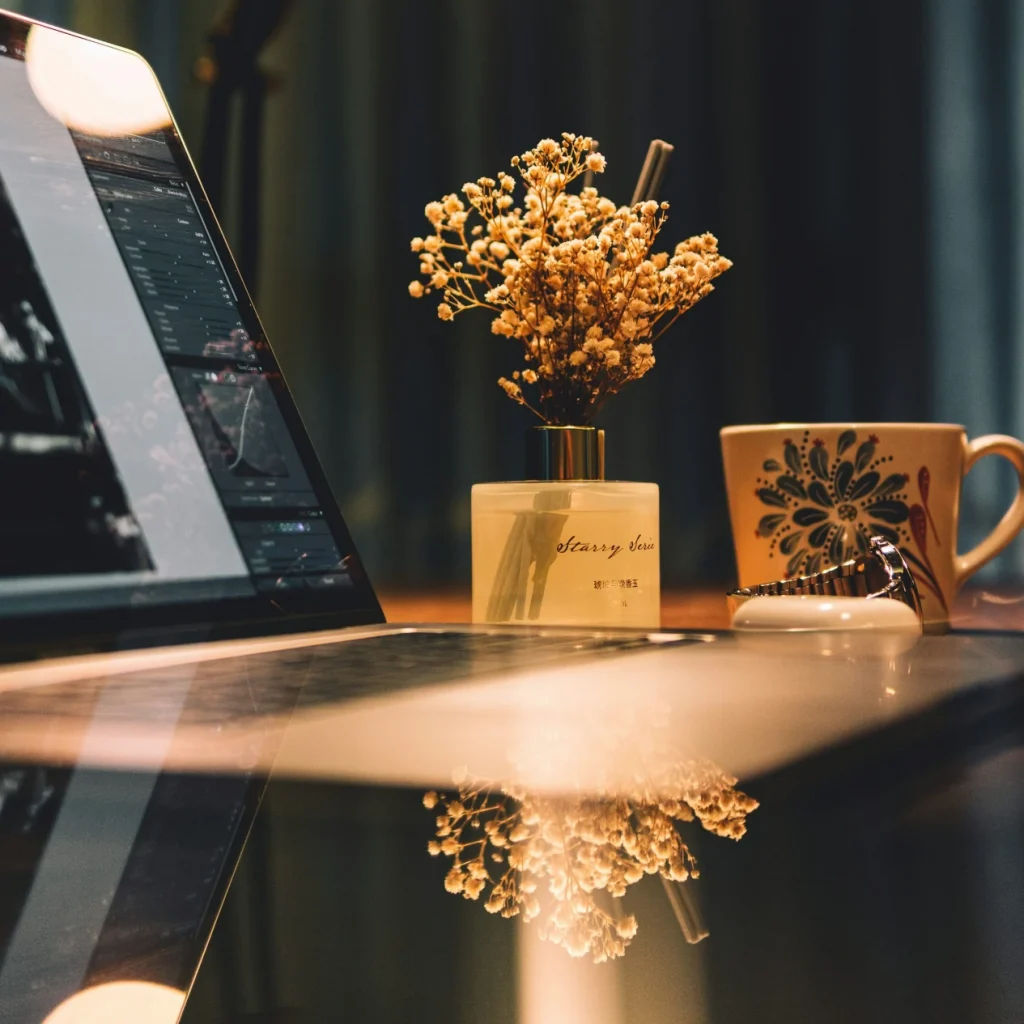
Those older spatial ideas — whether you call them supportive backing, open front, or a place for clear thought — are all pointing to the same thing: focus needs a sense of safety, creativity needs a sense of flow, and productivity needs a sense of order.
That isn’t superstition. It’s a very real human experience.
You may find that better productivity doesn’t always come from trying harder.
Sometimes, it comes from working in a space that supports you better.
May every time you sit down, it become a little easier to enter flow.