NEW JOURNAL NOTES ON SPACE, OBJECTS, AND EVERYDAY ATMOSPHERE
Visit Shop
Back to All Articles

The Ancient Engineering Secrets Hidden Inside the Temple of Heaven

In this article
A Building That “Talks”: The Acoustic Magic of the Echo Wall The “Three Echo Stones” The Hidden Mathematical Code Inside the Hall of Prayer for Good Harvests “Heaven Round, Earth Square”: Geometry as Philosophy The Wooden Structure That Survived Centuries Without Nails Architecture as a Way of Understanding the Universe What Can Modern Design Learn From Ancient China?

Most people visit the Temple of Heaven for the photos.

The deep blue roofs.

The perfect symmetry.

The iconic silhouette rising against Beijing’s sky.

But beneath its beauty lies something far more astonishing:

The Temple of Heaven is one of the most sophisticated examples of ancient architectural intelligence ever built.

What looks like a ceremonial complex is actually a masterpiece of acoustics, mathematics, astronomy, philosophy, structural engineering, and symbolic design — created more than 600 years ago, without modern technology.

And the deeper you look, the more unbelievable it becomes.

A Building That “Talks”: The Acoustic Magic of the Echo Wall

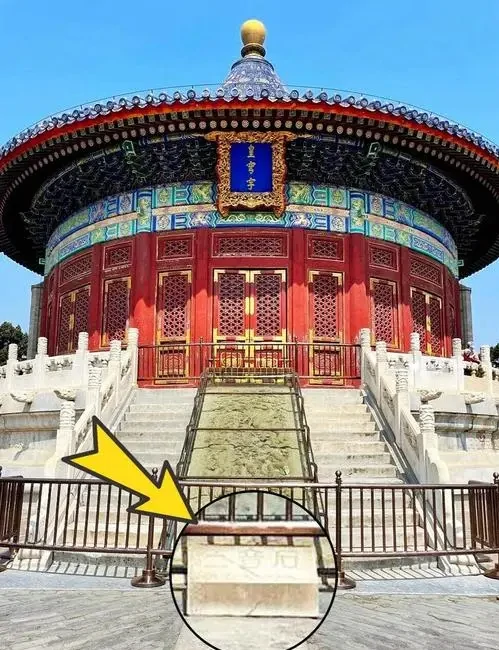
One of the most famous experiences at the Temple of Heaven happens at the Echo Wall surrounding the Imperial Vault of Heaven.

Visitors stand at opposite ends of the circular wall and whisper.

Somehow, the sound travels clearly across a surprisingly long distance.

At first, it feels almost supernatural.

But the real miracle is engineering.

The wall was built during the Ming Dynasty in 1420 — centuries before modern acoustic science — yet its design demonstrates an extraordinary understanding of sound reflection.

The secret lies in three things:

  • a nearly perfect circular geometry
  • an extremely smooth brick surface
  • carefully calculated curvature

When a person speaks near the wall, sound waves glide along the curved surface rather than dispersing randomly. The wall continuously reflects and carries the sound forward, allowing whispers to travel with remarkable clarity.

It functions almost like an ancient analog sound system.

The “Three Echo Stones”

Even more fascinating are the famous Three Echo Stones located in front of the Imperial Vault.

Stand on the first stone and clap once:

you hear a single echo.

Stand on the second:

two echoes.

Stand on the third:

three distinct echoes.

This effect was achieved through spatial calculations that controlled how sound bounced between the surrounding structures and returned to the listener at different time intervals.

In other words, ancient Chinese builders were manipulating acoustic timing through architecture itself.

Long before digital audio engineering existed, they were already designing immersive sound experiences in open space.
The Hidden Mathematical Code Inside the Hall of Prayer for Good Harvests

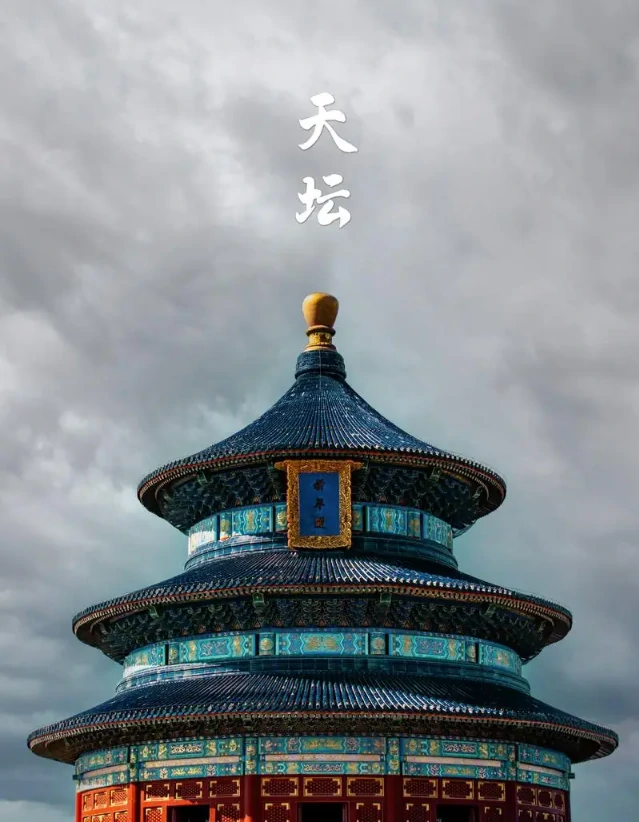
The Hall of Prayer for Good Harvests is the visual centerpiece of the Temple of Heaven.

Its triple blue roof is instantly recognizable.

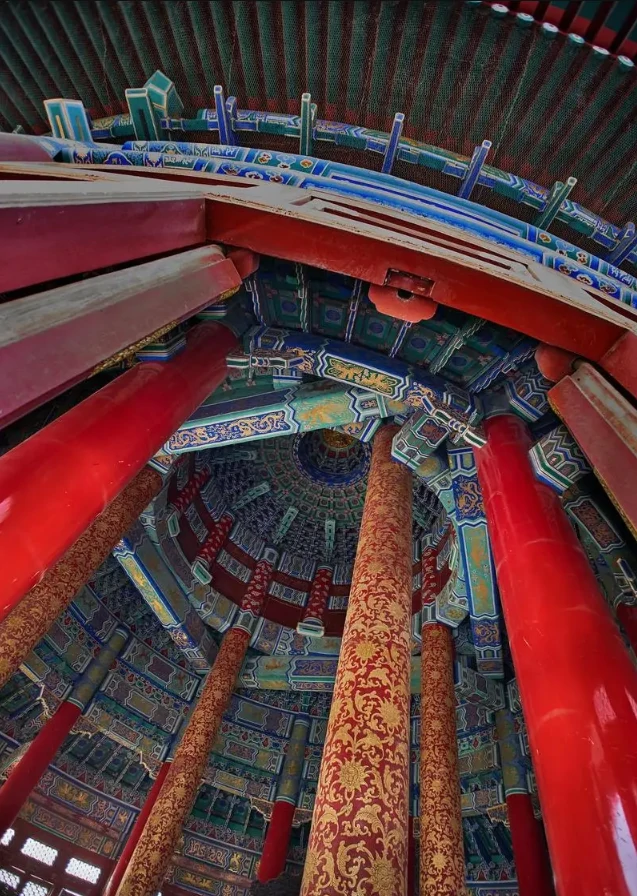
But its greatest secret is hidden in the columns.

Inside the hall stand 28 massive wooden pillars — and every number carries symbolic meaning.

The inner four pillars represent:

  • the four seasons

The middle twelve pillars represent:

  • the twelve months of the year

The outer twelve pillars represent:

  • the twelve traditional Chinese time periods of the day

Together, the middle and outer layers form 24 pillars:

  • representing the 24 solar terms of the traditional agricultural calendar

Finally, all 28 columns together symbolize:

  • the 28 constellations of ancient Chinese astronomy

This is far more than decoration.

The building itself becomes a physical model of time, cosmos, and agricultural civilization.

Rather than separating architecture from philosophy, traditional Chinese design merged them completely.

A building was not just a structure to occupy.

It was a way of understanding humanity’s relationship with the universe.

“Heaven Round, Earth Square”: Geometry as Philosophy

The entire layout of the Temple of Heaven reflects one of the most important ideas in traditional Chinese cosmology:

Heaven is round. Earth is square.

This concept appears everywhere in the complex.

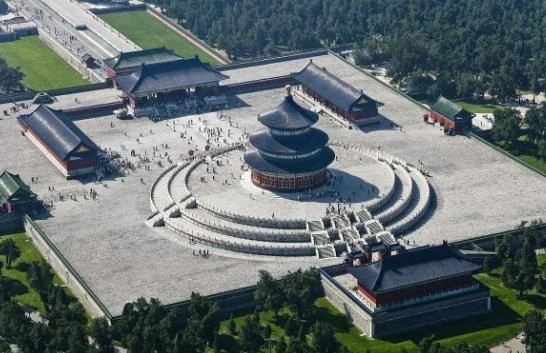
The Circular Mound Altar — where emperors performed ceremonies to Heaven — is composed entirely of circular forms and symbolic numbers associated with heaven and yang energy.

At its center lies the “Heavenly Heart Stone.”

Around it, concentric rings of stones expand outward:

  • 9 stones
  • 18 stones
  • 27 stones
  • continuing in multiples of nine

In traditional Chinese thought, nine represented the highest heavenly number.

The repeated use of circles and multiples of nine created a sacred spatial language linking the emperor, the cosmos, and divine order.

Meanwhile, surrounding structures connected to earthly preparation and ritual were designed with square layouts, representing earth.

The entire architectural journey through the complex becomes symbolic:

moving from the human world of the square toward the celestial world of the circle.

The Wooden Structure That Survived Centuries Without Nails

Perhaps the most astonishing aspect of the Temple of Heaven is something most visitors never notice:

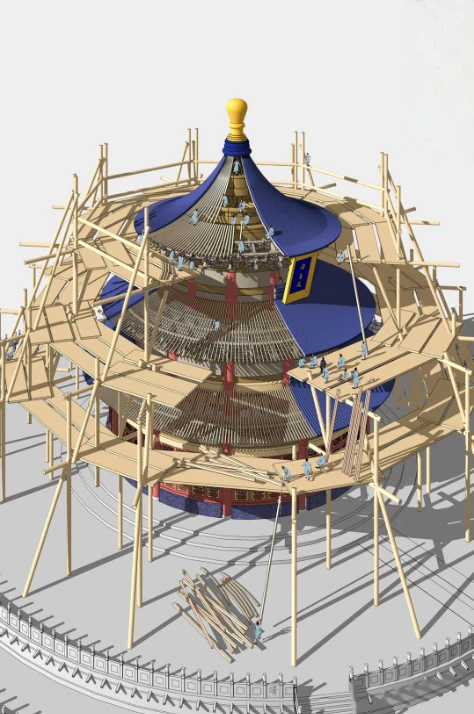
The main structures were built without iron nails.

Instead, ancient craftsmen used intricate interlocking wooden joints known as mortise-and-tenon construction.

These joints allowed the massive timber framework to flex slightly during earthquakes, temperature changes, and seasonal expansion.

Rather than resisting force rigidly, the buildings absorbed movement dynamically.

This flexibility is one reason many traditional Chinese wooden buildings survived for centuries despite earthquakes and harsh weather conditions.

Modern engineers continue to study these structural systems today.

The brilliance of the design lies not in overpowering nature, but in working with it.

Architecture as a Way of Understanding the Universe

The Temple of Heaven is not simply an ancient monument.

It is a three-dimensional philosophy book built from wood, stone, geometry, and sound.

Every detail contains meaning:

  • numbers reflect astronomy
  • layouts express cosmology
  • acoustics demonstrate scientific observation
  • structure embodies harmony and balance

What makes Chinese architectural wisdom remarkable is that it never separated technology from spirituality, or engineering from beauty.

Everything was connected.

Science, ritual, nature, mathematics, craftsmanship, and philosophy existed as one integrated system.

What Can Modern Design Learn From Ancient China?

Today, we live in an age of advanced digital tools, artificial intelligence, and increasingly complex architecture.

Yet many ancient Chinese buildings still feel more emotionally resonant, environmentally intelligent, and spiritually grounded than much contemporary design.

Why?

Because they were built with a different mindset.

Traditional Chinese architecture emphasized:

  • harmony instead of domination
  • adaptability instead of rigidity
  • symbolism instead of spectacle
  • long-term balance instead of short-term efficiency

The Temple of Heaven reminds us that architecture can do more than solve functional problems.

It can communicate ideas.

Shape human emotion.

Connect people to nature.

And express an entire civilization’s understanding of the universe.

That may be the greatest architectural wisdom hidden inside its walls.

Same category navigation

More to read next

From reading to action

Keep thoughtful guides close as you shape a calmer home.

Save ideas for later, explore room-based guidance, or share what you would like us to write about next.

Explore Room Guides Use room-based guides when you want a calmer way to choose placement, materials, and daily-use pieces.
Share A Future Topic Tell us what spaces, objects, or topics you'd like us to explore next. We’re always open to new ideas and inspiration.
Journal Dispatch

A quiet letter for spatial living.

Receive calm notes on placement, materials, and living with more spatial clarity.