How Dujiangyan Works: Ancient Engineering with Modern Intelligence
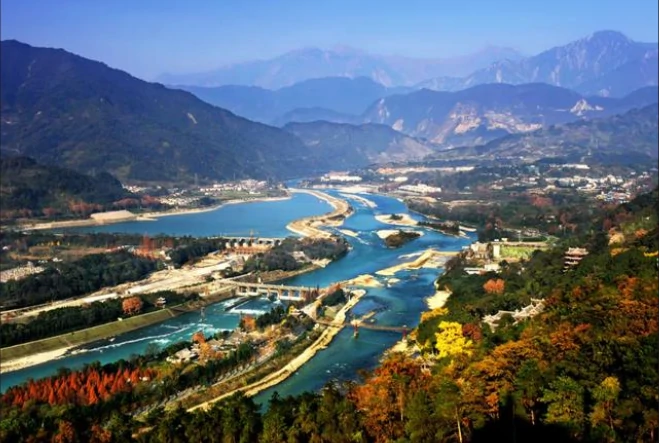
The brilliance of Dujiangyan lies in its simplicity.
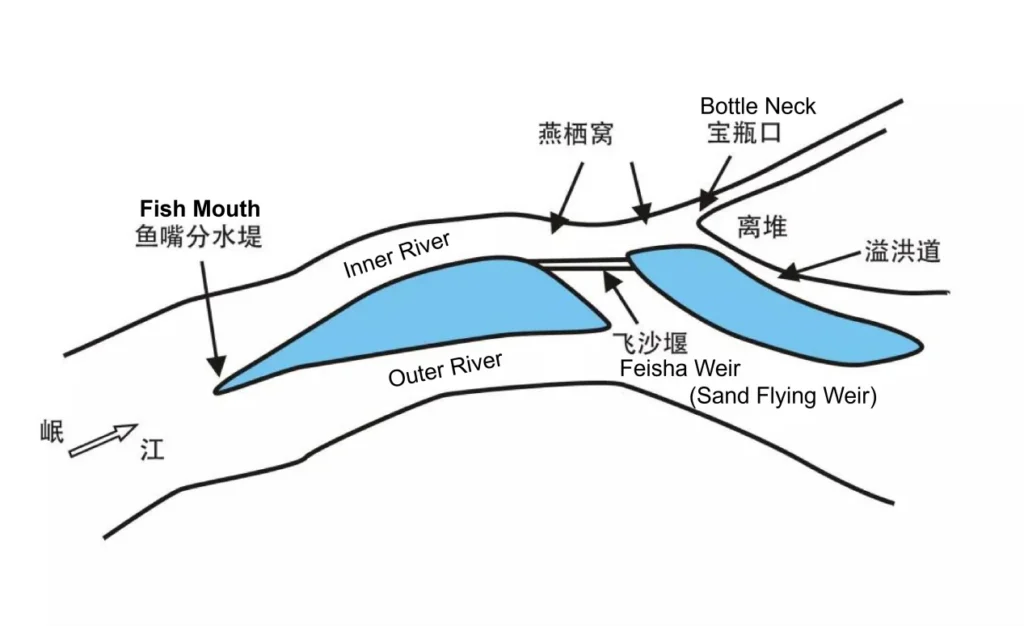
The entire system revolves around three core structures:
- Fish Mouth Levee
- Flying Sand Weir
- Bottle-Neck Channel
Together, they create a self-regulating hydraulic system without blocking the river completely.
The Fish Mouth Levee: Dividing the River Naturally
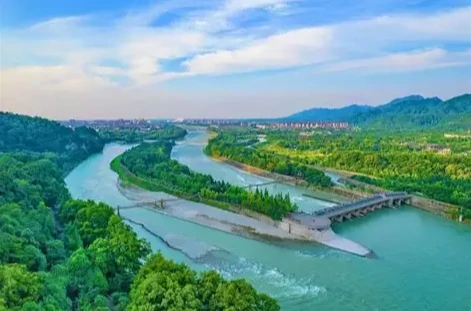
The Fish Mouth Levee is a long artificial island built in the center of the Min River.
Its shape divides the river into:
- an inner channel for irrigation
- an outer channel for flood discharge
During flood season, the wider outer channel naturally carries away excess water.
During dry seasons, water flows preferentially into the inner channel because of its lower riverbed elevation, ensuring stable irrigation.
This adaptive design allows the river to regulate itself seasonally.
Ancient Chinese engineers achieved dynamic water control entirely through terrain, geometry, and flow behavior.
No electricity.
No gates.
No modern machinery.
The Flying Sand Weir: Automatic Sediment Control
Sediment was one of the greatest challenges facing ancient irrigation systems.
Dujiangyan solved this problem elegantly.
When water levels rise, excess water flows over the Flying Sand Weir back into the outer river channel.
At the same time, the narrowing shape of the Bottle-Neck Channel increases water velocity and creates rotational flow patterns that naturally push sediment outward toward the spillway.
This prevents the irrigation channel from becoming clogged.
In modern terms, Dujiangyan integrated:
- flood control
- sediment flushing
- flow regulation
- water diversion
into one interconnected ecological system.
It is an astonishing achievement for the 3rd century BCE.