NEW JOURNAL NOTES ON SPACE, OBJECTS, AND EVERYDAY ATMOSPHERE
Visit Shop
Back to All Articles

Dujiangyan: The 2,300-Year-Old Chinese Water System That Still Works Today

In this article
The Engineering Miracle That Created the “Land of Abundance” How Dujiangyan Works: Ancient Engineering with Modern Intelligence A Philosophy of Cooperation with Nature Why Dujiangyan Still Matters Today The Living Wisdom of Water

In the modern world, massive dams are often seen as symbols of engineering power.

Concrete walls rise across rivers.
Water is blocked, redirected, and controlled through force.

But more than 2,300 years ago, ancient China created something radically different.

No giant dam.
No complete river blockage.
No attempt to overpower nature.

And yet, this system has continued functioning for over two millennia.

This is Dujiangyan — one of the oldest continuously operating water management systems in the world, and one of the greatest examples of ecological engineering ever built.

More than an ancient infrastructure project, Dujiangyan represents a philosophy:
not conquering nature, but understanding it.

The Engineering Miracle That Created the “Land of Abundance”

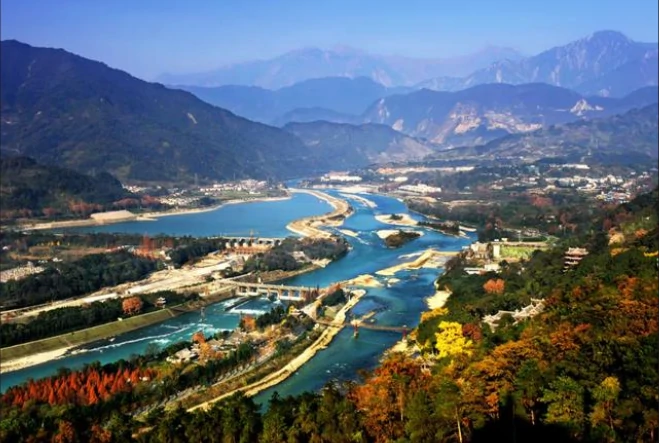
Located on the Min River near present-day Chengdu in Sichuan Province, Dujiangyan was built around 256 BCE during the Qin Dynasty by the governor Li Bing and his son.

At the time, the Chengdu Plain faced a paradox.

The region was fertile, but the Min River was unpredictable:

  • floods destroyed farmland during the rainy season
  • drought threatened crops during dry months
  • heavy sediment constantly clogged waterways

To transform the region into productive agricultural land, ancient engineers needed to solve all three problems simultaneously:

  • flood control
  • irrigation
  • sediment management

What they created was extraordinary.

Instead of building a dam to stop the river, Li Bing designed a system that worked with the river’s natural behavior.

That decision changed Chinese history.

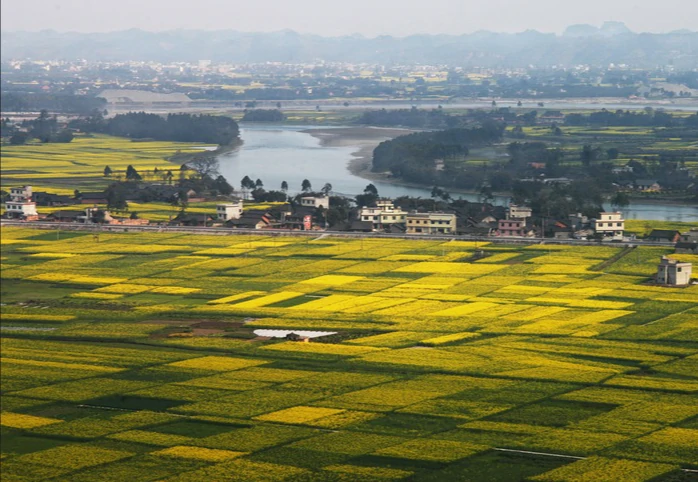
After Dujiangyan was completed, the Chengdu Plain became one of the richest agricultural regions in China — later known as the “Land of Abundance.”

Its productivity helped strengthen the Qin state economically, contributing to China’s eventual unification under the Qin Empire.

And remarkably, the system still irrigates vast areas today.

How Dujiangyan Works: Ancient Engineering with Modern Intelligence

The brilliance of Dujiangyan lies in its simplicity.

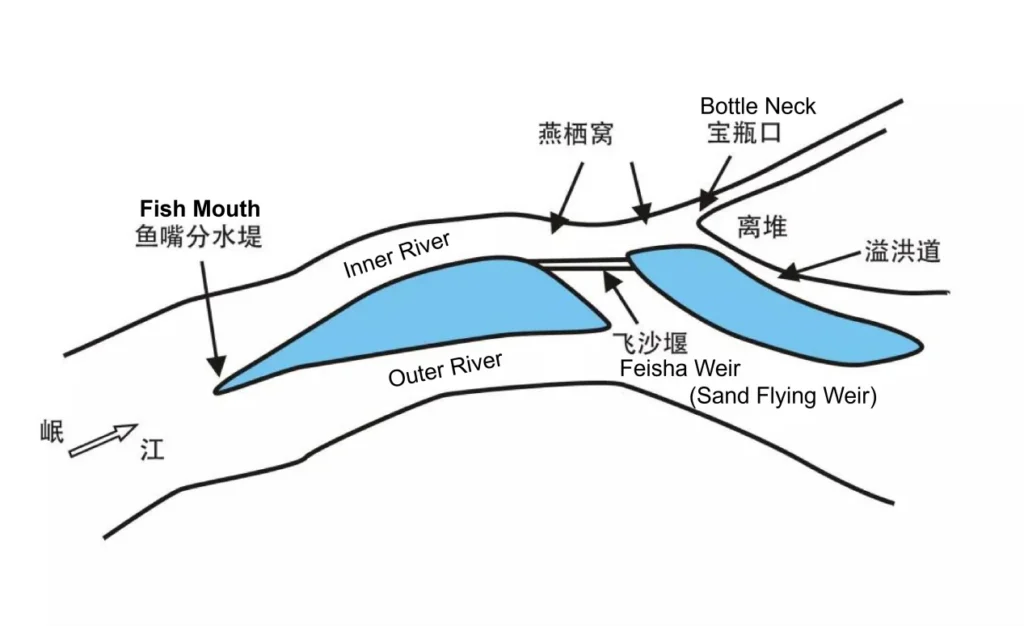
The entire system revolves around three core structures:

  • Fish Mouth Levee
  • Flying Sand Weir
  • Bottle-Neck Channel

Together, they create a self-regulating hydraulic system without blocking the river completely.

The Fish Mouth Levee: Dividing the River Naturally

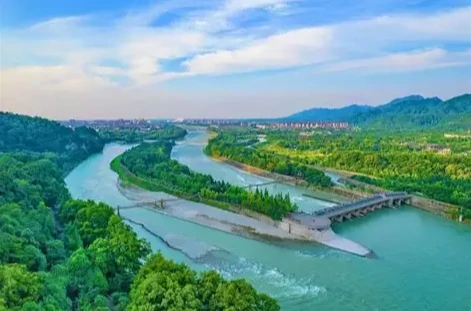
The Fish Mouth Levee is a long artificial island built in the center of the Min River.

Its shape divides the river into:

  • an inner channel for irrigation
  • an outer channel for flood discharge

During flood season, the wider outer channel naturally carries away excess water.

During dry seasons, water flows preferentially into the inner channel because of its lower riverbed elevation, ensuring stable irrigation.

This adaptive design allows the river to regulate itself seasonally.

Ancient Chinese engineers achieved dynamic water control entirely through terrain, geometry, and flow behavior.

No electricity.

No gates.

No modern machinery.

The Flying Sand Weir: Automatic Sediment Control

Sediment was one of the greatest challenges facing ancient irrigation systems.

Dujiangyan solved this problem elegantly.

When water levels rise, excess water flows over the Flying Sand Weir back into the outer river channel.

At the same time, the narrowing shape of the Bottle-Neck Channel increases water velocity and creates rotational flow patterns that naturally push sediment outward toward the spillway.

This prevents the irrigation channel from becoming clogged.

In modern terms, Dujiangyan integrated:

  • flood control
  • sediment flushing
  • flow regulation
  • water diversion

into one interconnected ecological system.

It is an astonishing achievement for the 3rd century BCE.
A Philosophy of Cooperation with Nature

What makes Dujiangyan truly remarkable is not only its engineering.

It is the worldview behind it.

Many ancient civilizations approached rivers as forces to restrain or dominate.

Dujiangyan followed a different philosophy:

understand the river, adapt to it, and guide it gently.

The system does not fight water through brute force.

Instead, it observes:

  • seasonal flow patterns
  • terrain gradients
  • sediment movement
  • river momentum

and uses those natural behaviors as part of the design itself.

This reflects a deeply rooted Chinese concept:

humans should live in harmony with nature rather than against it.

The wisdom of Dujiangyan lies in transforming natural energy into cooperation instead of conflict.

Why Dujiangyan Still Matters Today

More than two thousand years later, Dujiangyan continues to supply water to large parts of Sichuan Province.

It still supports:

  • agricultural irrigation
  • flood prevention
  • urban water supply
  • ecological balance

But perhaps its greatest importance today is philosophical.

In an era increasingly shaped by climate crisis, environmental degradation, and unsustainable infrastructure, Dujiangyan offers a powerful alternative model.

It demonstrates that the most intelligent engineering is not always the most aggressive.

Sometimes the greatest achievement is designing systems that:

  • adapt rather than dominate
  • cooperate rather than resist
  • sustain rather than exhaust

Modern engineers and environmental designers around the world are once again rediscovering principles that ancient Chinese builders understood centuries ago.

The Living Wisdom of Water

Dujiangyan is not a frozen historical relic.

It is living knowledge.

For over 2,300 years, flowing water has continued to test the system every single day — and every day, the system continues to work.

That may be its greatest proof of wisdom.

Stone can survive for centuries.

But only truly intelligent design survives alongside nature itself.

Dujiangyan teaches us that the highest form of engineering is not the domination of rivers, but learning how to move with them.

And perhaps that lesson is more relevant now than ever before.

Same category navigation

More to read next

From reading to action

Keep thoughtful guides close as you shape a calmer home.

Save ideas for later, explore room-based guidance, or share what you would like us to write about next.

Explore Room Guides Use room-based guides when you want a calmer way to choose placement, materials, and daily-use pieces.
Share A Future Topic Tell us what spaces, objects, or topics you'd like us to explore next. We’re always open to new ideas and inspiration.
Journal Dispatch

A quiet letter for spatial living.

Receive calm notes on placement, materials, and living with more spatial clarity.