NEW JOURNAL NOTES ON SPACE, OBJECTS, AND EVERYDAY ATMOSPHERE
Visit Shop
Back to All Articles

The Five Elements and Crystals: When Ancient Wisdom Meets the Language of Light

In this article
What Are the Five Elements? Crystals and the Five Elements: Starting With Their Material Nature Wood · Green Crystals · The Energy of Growth Fire · Red and Purple Crystals · Warmth, Passion, and Transformation Earth · Yellow and Brown Crystals · Stability and Support Metal · White and Clear Crystals · Clarity and Refinement Water · Black and Blue Crystals · Depth and Flow How the Five Elements Work Together: Combining Crystals The Optical Side of Crystals: The Language of Light Balancing the Five Elements in a Space In the End
Have you ever noticed that some crystals just feel right the moment you see them?

Amethyst feels calming.
Citrine feels bright and uplifting.
Black tourmaline feels grounding.
Clear quartz feels clean and mentally clarifying.

That is not entirely accidental.

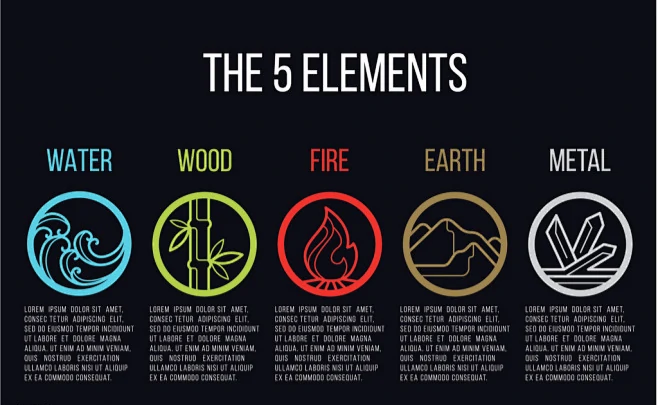
In the old Chinese system of the Five Elements, every color, texture, and energetic quality can be understood through five basic patterns in nature: Wood, Fire, Earth, Metal, and Water.

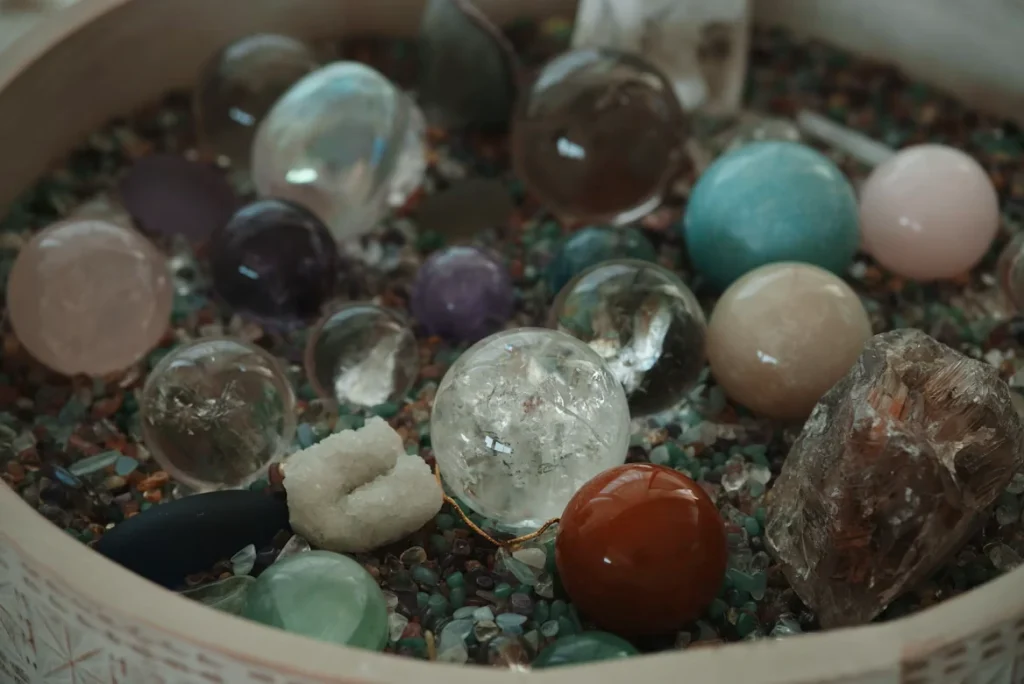
And crystals, in a way, are one of nature’s clearest expressions of those patterns.

What Are the Five Elements?

The Five Elements are not really five “things.” They are five states or ways energy moves.

Wood is growth. It rises, stretches, and carries life forward.
Fire is heat. It rises, expands, and gives warmth.
Earth is support. It stabilizes, centers, and nourishes.
Metal is clarity and structure. It contracts, refines, and brings order.
Water is flow. It sinks, softens, and moves through everything.

These five states are not fixed. They keep changing and generating one another.

Wood feeds Fire.
Fire creates Earth.
Earth gives rise to Metal.
Metal gathers Water.
Water nourishes Wood.

It is a cycle, like the changing seasons, or the movement from morning to night.

Everything in nature moves through this rhythm.

Crystals do too.

Crystals and the Five Elements: Starting With Their Material Nature

At the most basic level, many crystals are made primarily of silicon dioxide.

That sounds very scientific — but in an interesting way, it also fits beautifully with the Five Elements.

Silicon dioxide is one of the most common minerals on Earth. It is stable, hard, and often transparent. In Five Element language, those qualities already suggest something close to Earth: stability, containment, and substance.

But different crystals contain different trace elements. That is what gives them their wide range of colors, tones, and visual textures.

And those colors and textures often line up surprisingly well with the Five Elements.

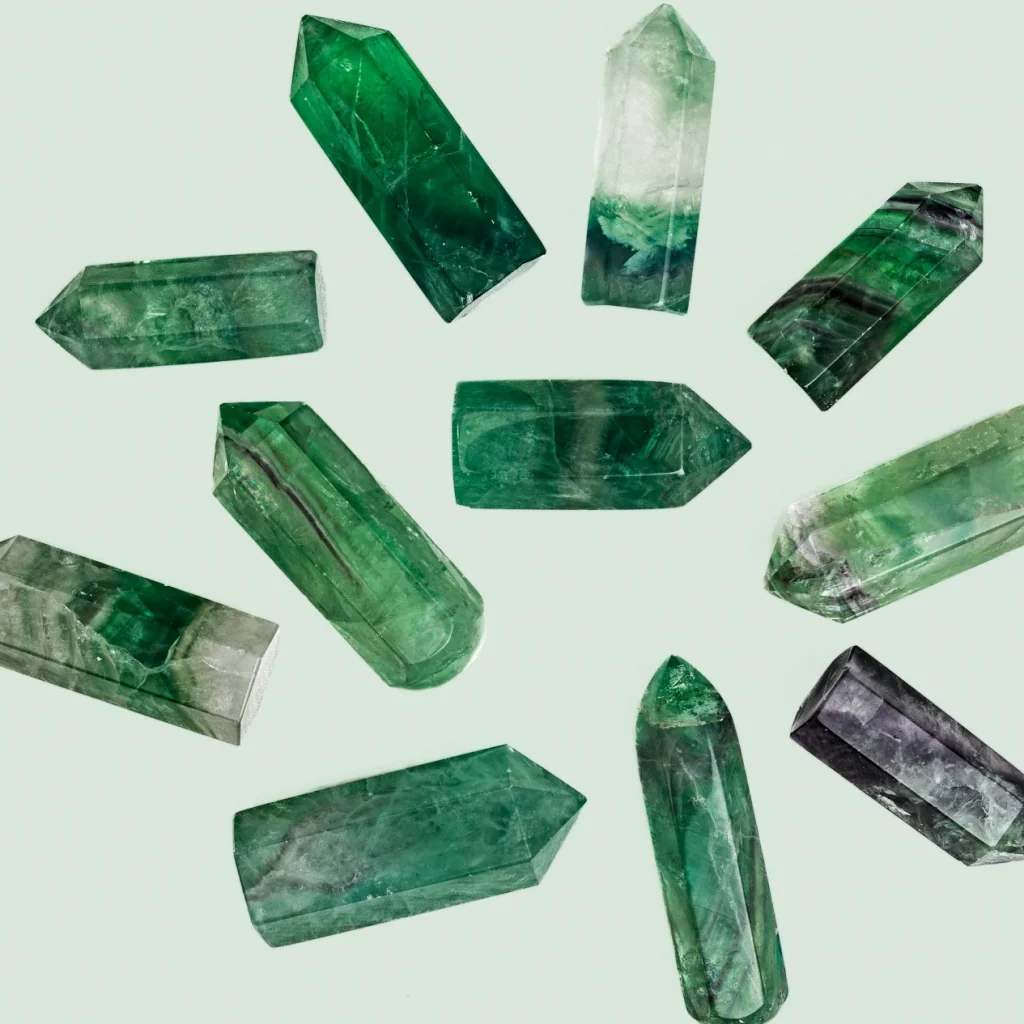
Wood · Green Crystals · The Energy of Growth

Examples: green phantom quartz, peridot, malachite

Green crystals often contain elements such as iron, chromium, or magnesium. Visually, they range from pale green to deep forest tones. Some are clear, some cloudy, and some seem to hold tiny landscapes inside them.

Wood is the energy of spring. It is morning. It is the moment a tree pushes upward.

That is why green crystals often feel alive. They do not feel static. Many of them seem to carry movement inside — like moss, forest, or something just beginning to grow.

Wood-type crystals are especially beautiful in places connected with growth: a desk, a study, near plants, or by an east-facing window.

They quietly remind us that some things are already unfolding, even when we cannot force the timing.

Fire · Red and Purple Crystals · Warmth, Passion, and Transformation

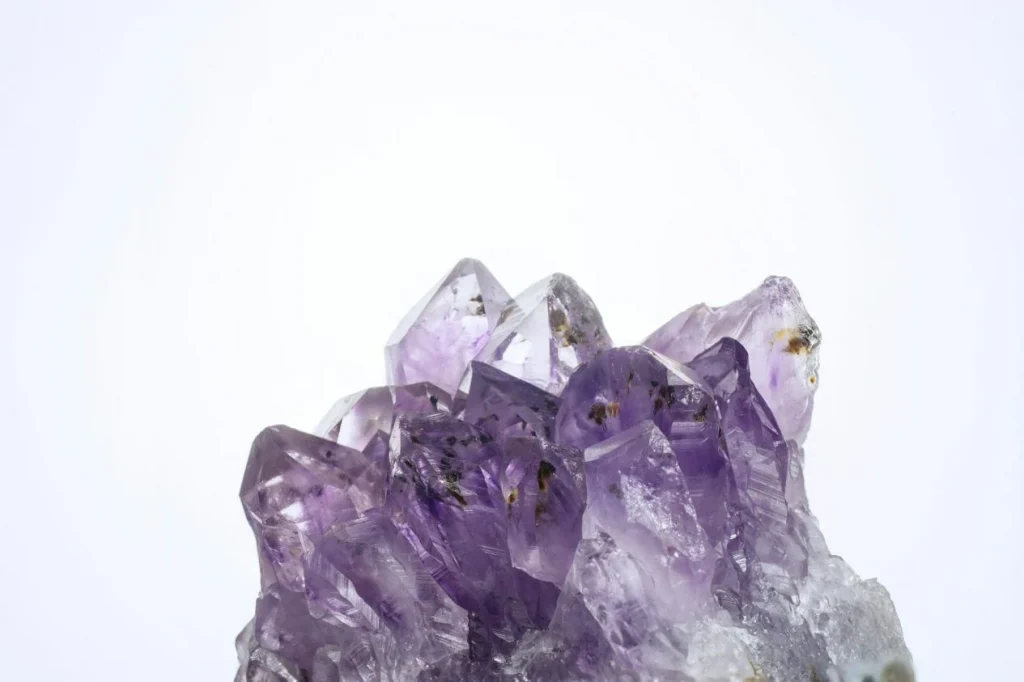
Examples: amethyst, ruby, garnet

These crystals often contain iron, manganese, or aluminum, and their colors range from red to deep purple. Some hold a glow that feels almost like internal flame.

Fire is summer. It is noon. It is warmth, light, and intensity.

Amethyst is especially interesting because its purple can be seen as a more refined form of Fire — not loud outer heat, but deeper inner heat. It is less dramatic than bright red, but often feels more inward, more concentrated, more transformative.

Fire-type crystals work well in places where focus, inspiration, or emotional warmth are needed: meditation spaces, creative corners, or south-facing rooms.

They help gather scattered energy and turn it into something more intentional.

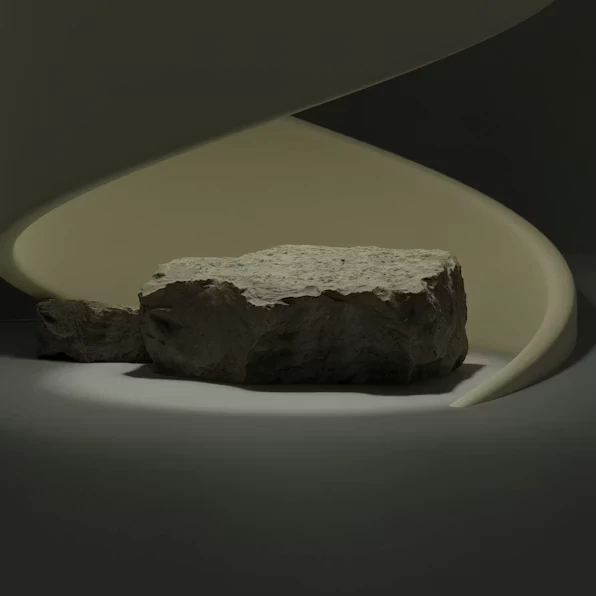
Earth · Yellow and Brown Crystals · Stability and Support

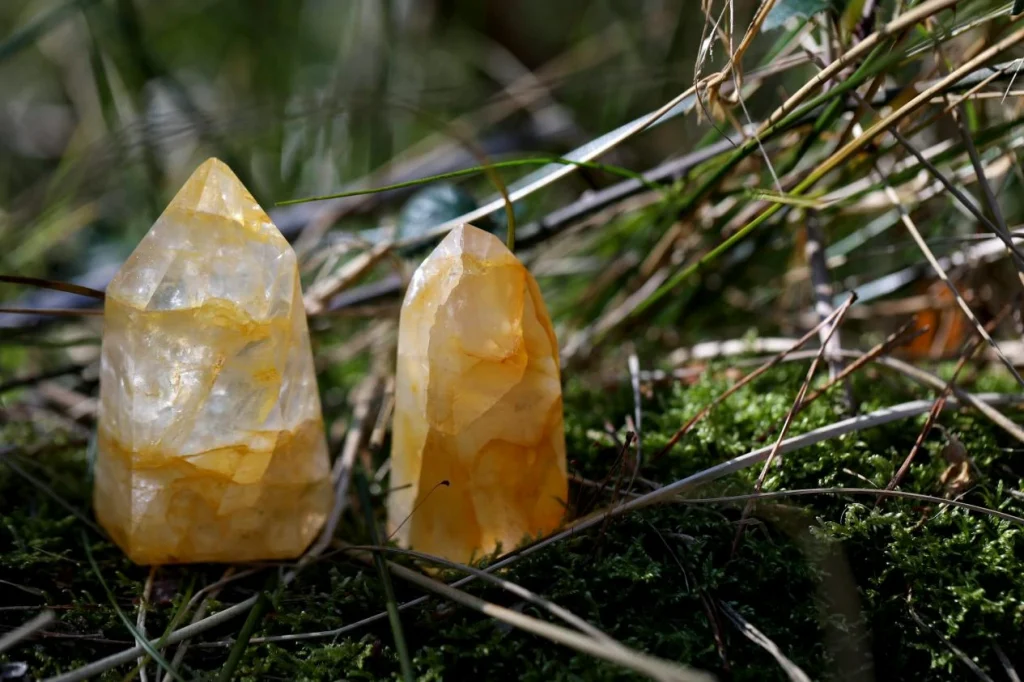
Examples: citrine, tiger’s eye, smoky quartz

These stones often carry tones of yellow, honey, gold, or brown. Many feel warm, dense, and reassuring. Some, like tiger’s eye, even have a silky glow that adds to their grounded feeling.

Earth is late summer. It is afternoon. It is the place where growth becomes rooted and held.

Citrine’s yellow feels like ripe grain or sunlight on dry ground. Tiger’s eye feels like soil, tree bark, or stone warmed by the sun.

These crystals do not float. They do not rush. They make people feel steadier.

Earth-type crystals work well in places that need support and balance: the center of a home, a work desk, or a living room where people gather.

They create the feeling that this is a place you can rely on.

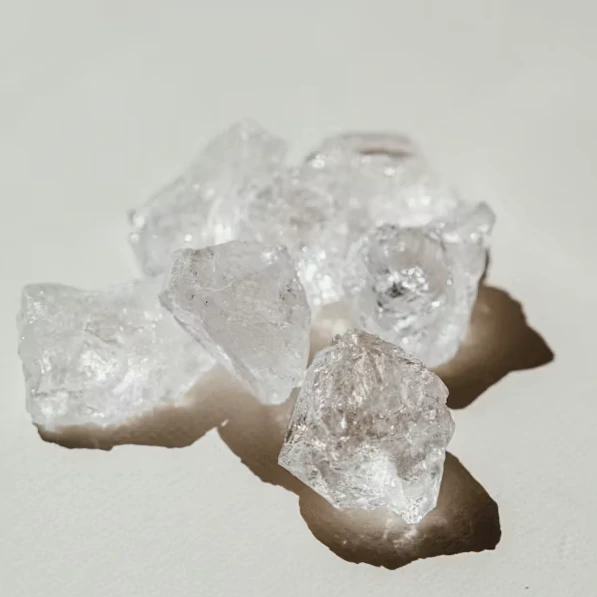
Metal · White and Clear Crystals · Clarity and Refinement

Examples: clear quartz, white quartz, moonstone

These crystals are often clear, white, or softly translucent. Their visual quality is cool, clean, and sharp. Some, like moonstone, carry a silvery glow that feels especially delicate.

Metal is autumn. It is evening. It is the time when things begin to gather inward, simplify, and return to essence.

Clear quartz is one of the purest expressions of Metal. It does not hide much. It is simply transparent, crisp, and direct.

Looking at clear quartz often gives a sense of mental order. It feels like excess can be cleared away, like thoughts can be sharpened, like only what matters needs to remain.

Metal-type crystals are especially useful in workspaces, studios, writing desks, or west-facing areas.

They support clarity, focus, and simplification.

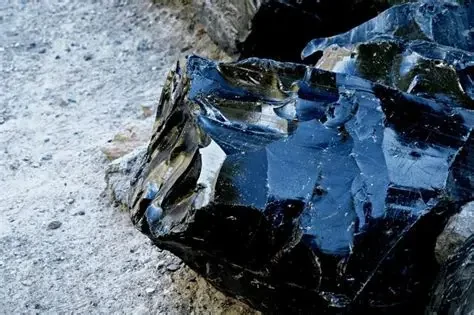
Water · Black and Blue Crystals · Depth and Flow

Examples: black tourmaline, aquamarine, labradorite

These crystals often contain iron, magnesium, or boron, and they tend to appear in dark black or blue tones. Some, like labradorite, flash with shifting blue light that feels almost like moonlight on water.

Water is winter. It is late night. It is depth, rest, and movement beneath the surface.

Black tourmaline feels like deep water — dark, quiet, hard to see through. Aquamarine feels more like shallow, clear water. Labradorite feels like water in motion, catching light in unexpected ways.

Water-type crystals work beautifully in places that need calm, flow, or emotional softness: entryways, meditation corners, north-facing rooms, or anywhere energy feels blocked.

They help things move again.

How the Five Elements Work Together: Combining Crystals

One of the most interesting parts of the Five Elements is not each element by itself, but how they support one another.

Green crystals with purple ones can feel like Wood feeding Fire — growth turning into passion and inspiration.

Purple with yellow can feel like Fire creating Earth — energy becoming grounded action.

Yellow with clear white can feel like Earth giving rise to Metal — stability turning into clarity.

White with black can feel like Metal supporting Water — clean thinking helping emotion flow.

Black with green can feel like Water nourishing Wood — deep quiet feeding new growth.

This does not have to be treated as rigid mysticism. It can also be understood as a way of creating visual and emotional balance.

Just as good interiors need rhythm, contrast, and breathing space, crystals can be combined to support a similar balance in feeling.

The Optical Side of Crystals: The Language of Light

Part of what makes crystals so fascinating is how their Five Element qualities also show up in the way they interact with light.

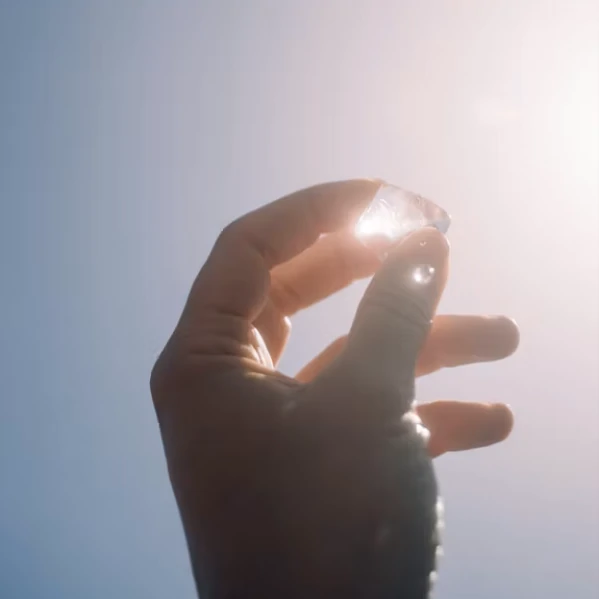
Refraction in clear quartz, which breaks light into a spectrum, can be seen as a very Metal-like quality: clarity, precision, and clean structure.

Reflection, as in moonstone’s soft blue sheen, feels more like Water: gentle, shifting, and fluid.

Absorption, as in black tourmaline, also feels Water-like — deep, silent, and inward. It takes in light rather than returning much of it.

Transmission, as in citrine’s warm golden glow, feels closer to Earth: stable, warm, and quietly supportive.

In that sense, every crystal has its own relationship with light. And that relationship becomes part of its “language.”

Balancing the Five Elements in a Space

The point of the Five Elements is not to collect every crystal possible.

It is simply to notice what your space may be missing — or what it may already have too much of.

If a room feels too cold or emotionally flat, it may need a little more Fire: perhaps amethyst, or even just warmer lighting.

If a home feels cluttered and mentally noisy, it may need more Metal: clear quartz, or simply a cleaner, emptier corner.

If a room feels stagnant and emotionally heavy, it may need more Water: black tourmaline, deeper tones, or a small water element.

If a space feels restless and ungrounded, it may need more Earth: citrine, stone objects, or heavier natural textures.

If a room feels stiff or lifeless, it may need more Wood: green crystals, fresh plants, or living, growing forms.

It does not take a dramatic change. Sometimes one small adjustment is enough to shift the feeling of the room.

In the End

The Five Elements are not a rigid set of rules.

They are a way of observing the world — a way of understanding how different qualities relate to one another.

Crystals are some of nature’s quietest messengers. They do not speak, but through color, light, texture, and mineral form, they show us what these five basic states can look and feel like.

The growth of Wood.
The warmth of Fire.
The support of Earth.
The clarity of Metal.
The flow of Water.

These qualities are not far away. They are already in your space — in the corners you pass every day, in the light on a shelf, in the stone you notice when you lower your eyes.

If you want, you can begin with just one crystal.

Look at its color.
Feel its texture.
Ask yourself what kind of state it carries.

Then ask something even simpler:

What does my space need more of?
And what does it already have enough of?

Sometimes, the answer is already sitting quietly inside the stone.

Same category navigation

More to read next

From reading to action

Keep thoughtful guides close as you shape a calmer home.

Save ideas for later, explore room-based guidance, or share what you would like us to write about next.

Explore Room Guides Use room-based guides when you want a calmer way to choose placement, materials, and daily-use pieces.
Share A Future Topic Tell us what spaces, objects, or topics you'd like us to explore next. We’re always open to new ideas and inspiration.
Journal Dispatch

A quiet letter for spatial living.

Receive calm notes on placement, materials, and living with more spatial clarity.