What feng shui can teach us about modern clutter habits
A lot of people think clutter is just a storage problem.
You bought too much. Your closets are too small. Your apartment has terrible built-ins. End of story.
But anyone who has ever walked into an overfilled room and instantly felt tired knows it is not that simple.
Sometimes a room is not just full of objects.
It is full of delayed decisions, visual noise, and a low hum of mental pressure.
Traditional feng shui would say the space is too blocked for qi to move well. Modern environmental psychology would describe it differently, but the core idea is surprisingly close: the spaces around us shape attention, mood, and stress.
Your room is not your soul — but it does leave clues
Psychologists have long noted that personal spaces can act like “behavioral residue.” In other words, the environments we create tend to leave visible traces of our habits, values, and preferences. A well-known study, A Room With a Cue, found that people could make somewhat accurate personality judgments from bedrooms and offices, especially around traits like conscientiousness and openness.
That does not mean your room is a perfect personality test. But it does mean the state of a space can tell us something about how someone lives: whether they lean toward structure, whether they are under pressure, or whether they are leaving too many things unresolved.
Why clutter feels heavier than it looks
One reason clutter is so tiring is that the brain does not really ignore it as well as we think it does. Research on visual attention shows that when multiple things compete in the visual field, they also compete for neural representation. That makes it harder to focus and more mentally fatiguing over time. Princeton’s summary of this line of research puts it very simply: visual clutter competes with attention and wears down cognitive energy.
That is why an overfilled room can feel “loud” even when nobody is talking.
The room keeps asking your eyes to sort, filter, and dismiss.
And if your eyes keep working, your mind rarely gets to fully rest.
Feng shui is less about adding things than people think
One of the biggest misunderstandings about feng shui is that it is mainly about buying objects.
A crystal here.
A mirror there.
A lucky charm for this corner.
A cure for that problem.
But traditional feng shui is not just about what you add. It is also about what you remove. A room that feels blocked, crowded, and visually congested is rarely improved by adding even more items to it. The first move is often subtraction: clear the path, open the sightline, let the room breathe.
In that sense, feng shui can feel surprisingly modern. A good space is not necessarily the one with the most personality packed into every corner. It is the one that allows the body and mind to settle.
Modern clutter is often emotional, not practical
People do not only keep objects because they are useful.
They keep them because objects can hold memory, guilt, fantasy, identity, or the promise of a future self.
That sweater is not just a sweater.
It is the version of you who might wear it someday.
That unread stack of magazines is not just paper.
It is the version of you who will eventually “have time.”
That box of random cables is not just junk.
It is insurance against making the wrong decision.
This is one reason clutter becomes sticky. It is rarely just about square footage. The American Psychological Association has pointed out that clutter can be tied to procrastination, overwhelm, emotional attachment, and, in more severe cases, hoarding disorder.

Messy does not automatically mean bad — but there is a limit
This is where the conversation gets more interesting.
Psychology does not support a simple rule like “messy people are creative geniuses” or “tidy people are boring.” Real life is more nuanced. Some studies have found that orderly rooms can encourage more conventional, rule-following behavior, while disorderly rooms may support more unconventional responses on certain creativity tasks. But that does not mean the messier the room, the more gifted the person. It just means environments can nudge behavior in different directions.
So yes, a slightly messy room may sometimes reflect flexibility, spontaneity, or creative looseness.
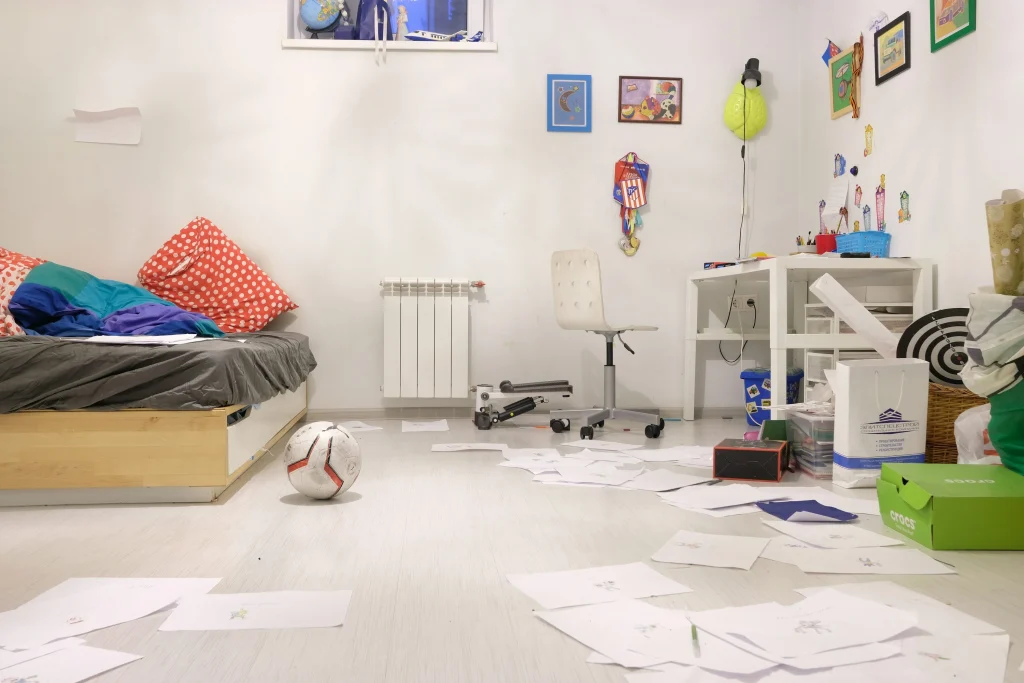
But if a room is so cluttered that it becomes hard to think, move, sleep, or function, that is no longer “creative chaos.” That is friction.
The real question is: is your space supporting you, or quietly draining you?
That is the most useful shift.
Instead of asking, Am I tidy enough? or Am I too messy?
Ask this:
Is this room helping me live, or is it quietly exhausting me?
If a room makes it harder to focus, harder to relax, harder to clean, and harder to move through, then the issue is not style. The issue is support. And when a room keeps demanding attention in the background, it often adds to the mental load you are already carrying.
Feng shui would call that blocked flow.
Modern psychology might call it cognitive overload.
Either way, the experience is real.
Why this matters even more in modern life
Modern clutter is not always dramatic. Often it looks normal.
Online shopping piles.
Multi-use furniture full of forgotten things.
Decor that turned into storage.
A room full of “useful” items that somehow still feels oppressive.
That is why this matters now more than ever. We live in a culture that makes accumulation easy and letting go weirdly difficult. So sometimes the room starts reflecting not our needs, but our postponements.
And when space gets too full, thoughts often do too.
A softer way to think about it
The healthiest takeaway is not “mess is genius” or “tidiness is virtue.”
It is this:
Your room is feedback.
A tidy room may reflect structure, self-regulation, and a preference for order. A cluttered room may reflect stress, overwhelm, low bandwidth, or a more improvisational personality. Sometimes it reflects who you are. Sometimes it just reflects a very rough month.
Either way, it is not a moral score.
It is information.